
INTRODUCING LUCY ANDREW
WHO ADAPTS JANE AUSTEN TO HER OWN (EVIL) ENDS

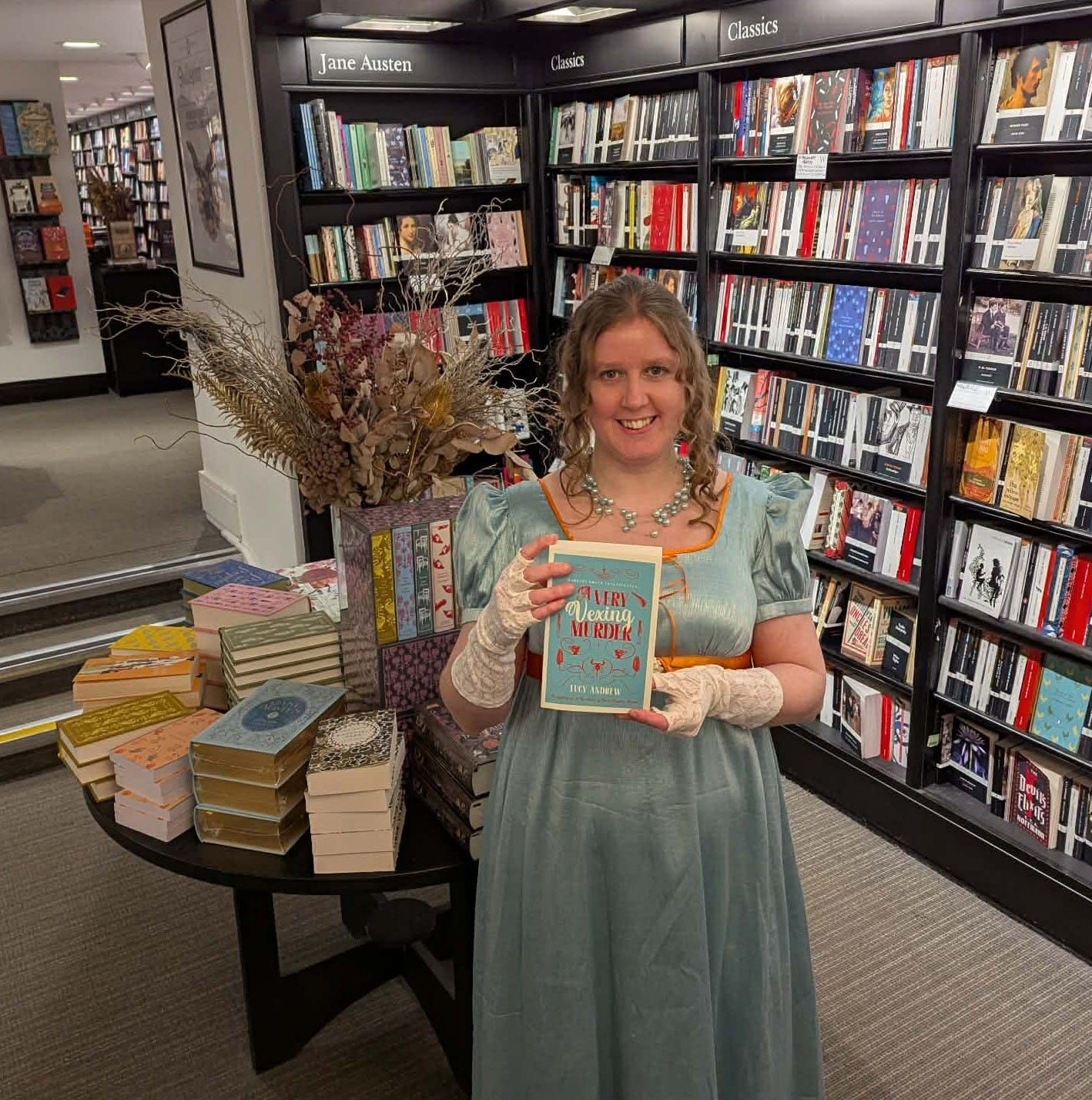
Author Lucy Andrew, in Regency dress, at her book launch at Waterstones in Bath
WHAT HAPPENS WHEN JANE AUSTEN MEETS A COSY MYSTERY?
YOU HAVE A VERY VEXING MURDER, of course!
LUCY’S CHILDHOOD AND THE BEGINNINGS OF HER LITERARY LIFE
Tell us about your childhood. You were always enthralled by mysteries? A bookworm child?
I was definitely a bookworm child. As a younger sibling, I had all my sister’s hand-me-down books to read, plus lots of my own, and I spent a lot of time reading in my local library. I was pony mad as a child, so much so that my primary school form teacher challenged me to read one none-pony book a month. And so I picked up Carolyn Keene’s The Secret of Shadow Ranch, the fifth book in the Nancy Drew series. The mystery involved a phantom horse and there was a horse on the front cover, but I confidently informed my teacher that it was a detective novel and I was hooked on Nancy Drew from then onwards.
HER EARLY CAREER
If I remember correctly, you’ve had a career in academia. Did academia suit you like slipping your hand into a glove, or was it a slog?
Yes, I gained a PhD in English Literature from Cardiff University in 2014 and was a Senior Lecturer in English Literature and Creative Writing at the University of Chester and Programme Leader of the English degree at University Centre Shrewsbury before leaving academia to focus on my writing. Academia was challenging, but I loved the research and public engagement side of it and that came to me quite naturally.
What lessons did you take away from your time in academia?
It definitely taught me resilience and persistence, which are both very useful characteristics to develop as a writer. It also taught me a lot about how to edit my work – the academic editing process can be really arduous, so years of practice of responding to reviewer and editorial feedback on my work really stood me in good stead for tackling the editing process for my fiction.
WHAT DREW YOU TO CRIME FICTION?

IS IT THE PUZZLE SOLVING, THE TWIST IN THE TALE?
Definitely the puzzle-solving, and I do love a good twist! But I think the key thing for me has always been the detective and the sidekick – the way they interact and go about solving the mystery. I’m often drawn to peripheral characters (hence writing a retelling with Harriet Smith as the heroine!) and I actually co-edited an academic book on sidekicks in crime fiction with Samuel Saunders, The Detective’s Companion in Crime Fiction: A Study in Sidekicks, as we wanted to shine a light on the sidekick figure and their often-overlooked significance in crime fiction.
TELL US ABOUT THE PROCESS OF WRITING THE BOOK…
How long did it take you to write it? Once finished, was it a long process to find your agent, your publisher? Was the whole publishing game a trial, or did you relish it? How are you adapting to marketing your book? Or is your publisher handling most of it?
A Very Vexing Murder went through three completely different versions over a five-year period. It started off life as a Young Adult novel, but finally became an adult crime book after feedback from agents that it would sit better with an adult audience.
And, at the time I started writing version three, Richard Osman’s Thursday Murder Club was everywhere and had catapulted cosy crime to a new level of popularity, so I found the right subgenre for my book at the right time.
It was a long process for me to find an agent – I was in the querying trenches a long time with my YA versions of the novel, with some full manuscript requests and useful feedback, but no offers.
Things changed for me when I started entering competitions with version three of the novel and got shortlisted in some crime fiction competitions.
I actually secured my agent, Euan Thorneycroft, via a competition. His agency, A.M. Heath, ran a crime fiction competition and I was the runner-up and he offered me representation at this point.
From there, we worked on the manuscript together and then went on submission in the UK, where we got a deal with Corvus (Atlantic Books) and then the US, where the book went to auction, which was won by William Morrow (HarperCollins).
THAT SOUNDS EXCITING! A BIDDING WAR – EVERY WRITER’S DREAM!
HOW HAVE YOU FOUND THE PUBLISHING “GAME”?
Publishing can move very slowly at times, so there are periods where lots of things are going on behind the scenes and you’re waiting to play your part in it, and then there are periods where you have to act very quickly to meet deadlines.
AND WHAT ABOUT MARKETING?
Marketing is certainly something that I’ve had to adapt to! There are some parts of it that I was already doing – particularly running events, as I was the public engagement co-ordinator for the English department at University Centre Shrewsbury, so that’s something I felt comfortable with.
But there are so many facets to marketing your books and it takes up a lot of time and energy. That has been the biggest adjustment, trying to balance writing time with marketing time.
I did some marketing mentoring with Anna Caig, who is a marketing expert and author who specifically focuses on marketing mentoring for authors and she gave me some great ideas to focus on – many of which I still need to put into practice. The most important thing she taught me about marketing was to be selective – you can’t possibly cover all avenues at once, so work out what you want to prioritise.
ARE YOU WORKING ON BOOK TWO? IS IT A FOLLOW-ON, OR SOMETHING COMPLETELY DIFFERENT?
I’ve just finished my first set of edits on book two, which is the second book in the Harriet Smith Investigates series. This book sees con-woman-turned-detective, Harriet Smith, and her long-suffering sidekick, Robert Martin, enter into the world of Jane Austen’s Northanger Abbey to solve crimes in high society in Bath. So we’re still in Austen’s world and Harriet’s world, but I’m introducing new characters and settings. It’s a new stage of Harriet’s journey as a detective.
I got to do lots of on-location research in Bath for this one, which was great fun! The book contains lots of real-life Georgian locations including the Assembly Rooms, the Bath Theatre Royal, the Pump Room and Sydney Gardens.
TELL US ABOUT YOUR CAREER GOING FORWARD
Is it going to be a mix of academia and writing books?
I would definitely like to keep my hand in with some academic work as well as writing novels. This year I’ve been working on three academic book chapters on Nancy Drew, the first of which is due out later this year.
And I’m also working on a book chapter on Catherine Eddowes, the Wolverhampton-born victim of Jack the Ripper and looking at how she is represented in fiction.
I PRESUME YOU MUST BE A BIG JANE AUSTEN FAN. HOW MANY TIMES HAVE YOU READ HER WORK? DO YOU GET CAUGHT UP IN HER WORLD?
I’ve been in love with Jane Austen’s novels since I studied Emma and Pride and Prejudice at A-Level. I’ve read her books too many times to count, but some I return to more than others. Emma, of course, is the one I’ve read the most times, but Northanger Abbey and Pride and Prejudice have had many re-reads and I taught both of these books to undergraduates.
For me it’s the humour, voice and characters that draw me in. Austen is so witty and her characters are so well-drawn: we all know a Mr and Mrs Bennet, a Mr Collins, a Lady Catherine.
And Austen is also a master of dialogue – she can show you someone’s character in a single line.
I also see Austen as a proto-detective novelist – she uses many techniques and characteristics in her work which later become staples of detective fiction, particularly in the Golden-Age detective fiction of Agatha Christie and co.
If you want to find out more about this, you can join my Secret Sleuths Club to gain access to an exclusive article, ‘Five Ways Jane Austen Paved the Way for Golden-Age Detective Fiction’. You’ll also receive my monthly author newsletter.
ARE YOU A PLOTTER OR A PANTSER?
Always a plotter! It comes from my academic training. I like to trick myself into writing by constructing very detailed plans which basically end up as a rough draft of my novel.
I use what Sophie Hannah calls the gnocchi draft method – half-writing, half-planning – so that when I come to sit down and write my first draft, I know most of what is going to happen and I only have to concentrate on using the right words to convey the story, rather than constructing the entire story from scratch.
I find it makes it much easier and quicker for me to write this way – there’s far less pressure and it helps me to overcome the fear of the blank page. It also means that, if I only have small chunks of writing time here and there, I can dip in and out of the draft without losing my place.
DO YOU HAVE ANY “INSIDE KNOWLEDGE” ABOUT JANE AUSTEN, THAT ISN’T WELL KNOWN?
It’s not an unknown fact, but one of my favourite Jane Austen facts is how long it took for Northanger Abbey to get published. Austen wrote it in the 1790s, when Gothic fiction was at its zenith, and sold it to a publisher in 1803. When they failed to publish the novel after several years, Austen was finally able to buy back the novel in 1816 for the price she sold it to them.
Her brother, Henry Austen, oversaw the posthumous publication of the novel in 1817. Austen did do some revisions to the novel before her death, but began the book with a preface which drew attention to the gap between composition and publication of the novel: ‘The public are entreated to bear in mind that thirteen years have passed since it was finished, many more since it was begun, and that during that period, places, manners, books, and opinions have undergone considerable changes.’ (Jane Austen, ‘Preface’, Northanger Abbey).
HOW DO YOU FIND RESEARCHING MURDERS? ARE THEY FROM YOUR IMAGINATION, OR REAL LIFE CASES?
I have quite a strong stomach for this kind of thing and read and watch a lot of true crime, alongside lots of crime fiction. So I’m well-versed in murder! The benefit of writing historical crime fiction is that you don’t have to go into forensic detail and with cosy crime the murders can’t be too brutal.
ARE THERE ANY MURDERS YOU’VE FOUND THAT ARE TOO BIZARRE FOR WORDS?
So I definitely draw more from fiction rather than from real life, although I have come across a lot of real-life bizarre cases, particularly in nineteenth-century crime reportage. Crime reportage in Victorian England was often pretty brutal. The ones that stick with me, because of my own research interests, are the horrific murders of Jack the Ripper’s victims, which were particularly shocking for the mutilations inflicted on the women’s bodies after death.
I always find the most interesting fictional murders to be those where the bodies appear in strange places, confined settings or where it’s not clear how the murder occurred – think Agatha Christie’s The Body in the Library, Arthur Conan Doyle’s ‘The Adventure of the Speckled Band’ and Fergus Hume’s The Mystery of a Hansom Cab.
If you would like to order Lucy Andrew’s book: A Very Vexing Murder, you can purchase the book here.
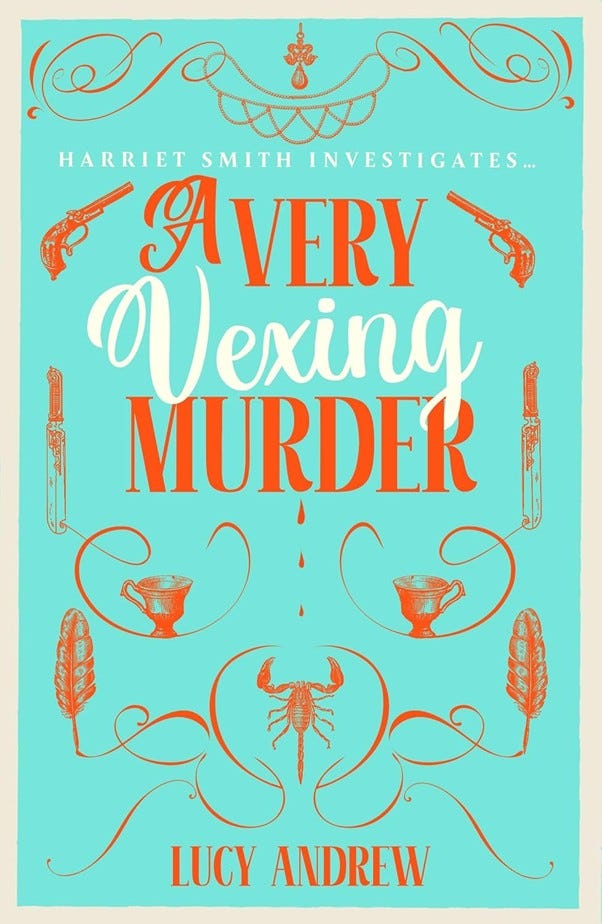
A Very Vexing Murder, the first book in the Harriet Smith Investigates series, is a cosy crime retelling of Jane Austen’s Emma which transforms Emma’s timid sidekick, Harriet Smith, into a feisty con-woman-turned-detective who is hired to investigate a murder that hasn’t yet been committed.
Lucy Andrew describes herself as a crime writer and crime fiction scholar with an unhealthy fixation with Jane Austen. Her debut novel, A Very Vexing Murder – a cosy crime retelling of Jane Austen’s Emma featuring con-woman-turned-detective Harriet Smith – was published by Corvus (Atlantic Books) in the UK and William Morrow (HarperCollins) in the US in early 2026.
A second book in the Harriet Smith Investigates series is due out in 2027. To find out more about Lucy’s work and receive her monthly author newsletter, you can sign up to her Secret Sleuths Club here.
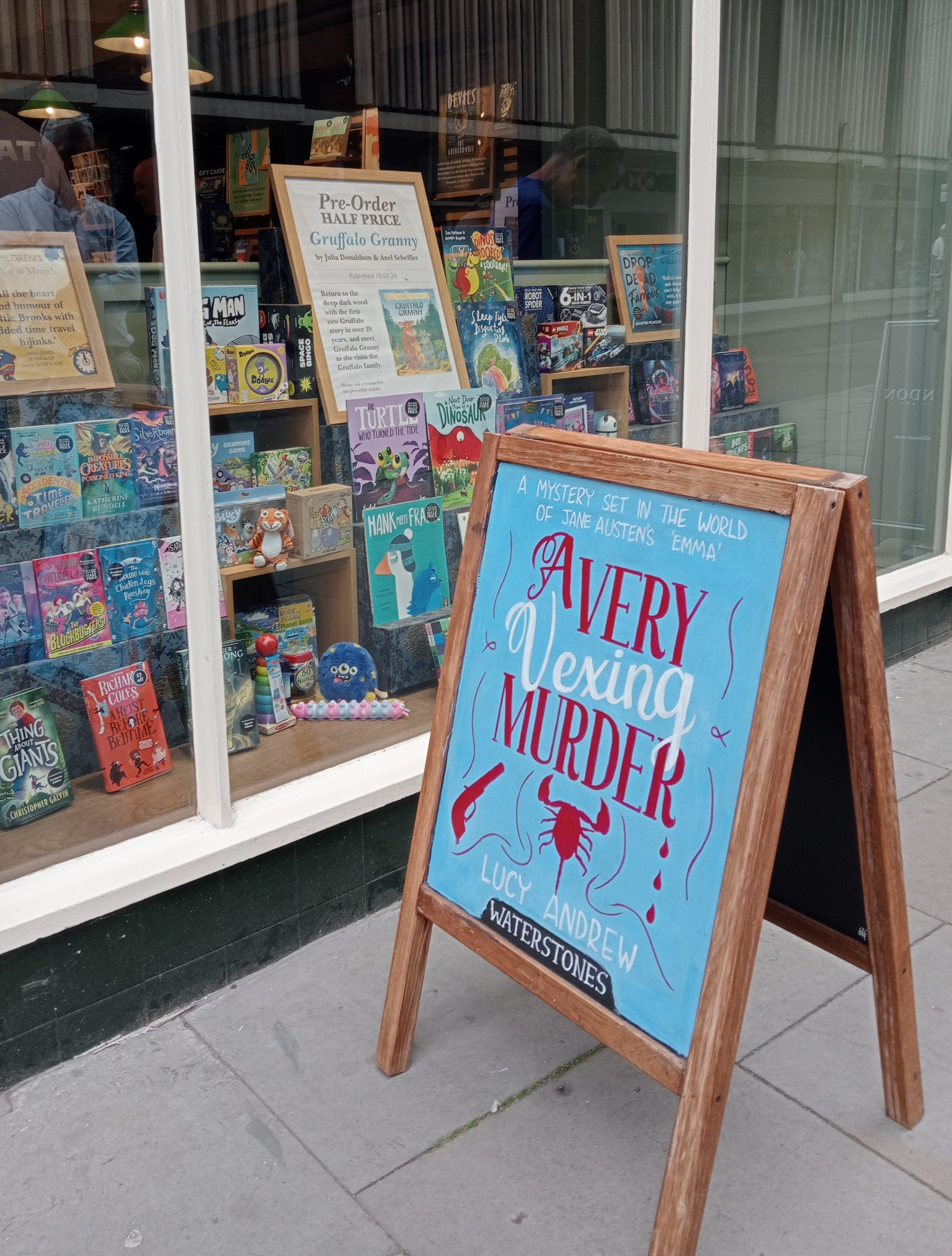
The bookstore, Waterstones, doing its promotional job outside the store.
Thanks so much inviting me onto your Substack, Rose! I had a great time answering your questions!
Looking forward to reading the book.